

For years, the go-to business model was simple: build a great SaaS product, run paid ads, hire a sales team, and scale. But as customer acquisition costs rise and inboxes get noisier, more SaaS companies are turning to something a little more sustainable: the reseller program.
Whether it’s an affiliate program driving traffic, a referral program rewarding loyal users, or a white-label partnership that lets agencies launch their own branded tools, partner-led growth is quickly becoming a SaaS partnership strategy.
According to Canalys, around 38% of all software-as-a-service (SaaS) revenue now flows through partners, a number expected to grow as the market matures. For some giants like Salesforce and Microsoft, it's well over 70%.
In this guide, we’ll break down the major types of SaaS resellers: from value-added resellers to MSPs, from consultants to distributors. We’ll also show you how tools like SaaS Browser can help resellers and SaaS teams spot the most promising opportunities.
You’ll walk away with a clearer picture of which reseller partnership fits your goals and how to choose the right model for your product.
Partner-Led Growth Is Taking Over SaaS
The appeal makes sense, to put it simply.
The right reseller partner can help SaaS providers break into new markets. It can offer additional services like onboarding or customer support, and even manage complex deployments as a managed service provider.
At one point, especially as a solo SaaS developer, you have to realize it’s not just about selling licenses. It’s about creating value and scale through the right partnership.
But here’s the thing: not every partner program or SaaS reseller program is built the same. And not every SaaS provider or potential reseller, should treat them like they are.
What is a SaaS reseller?
A SaaS reseller is a third-party individual or company that sells software-as-a-service (SaaS) products on behalf of the original provider, often earning a commission or margin. SaaS resellers may simply promote the product or take on more responsibilities like handling sales, onboarding, or support.
What are all the types of SaaS resellers?
The main types of SaaS resellers include affiliate partners, referral partners, authorized resellers, value-added resellers (VARs), white-label resellers, managed service providers (MSPs), system integrators (SIs), consulting or solution partners, and distributors in two-tier reseller programs. Each type offers different levels of involvement, from simple promotion to full-service delivery and branding.
1. Affiliate partners in SaaS reseller programs
If you're looking for one of the easiest ways to get into SaaS reselling, the affiliate model is a great starting point.
In this type of partnership, resellers don’t manage pricing, support, or customer relationships. Instead, they sell software by promoting it. When someone signs up through their link, they earn a commission.
That simplicity is why SaaS affiliate programs are among the most common types of SaaS partner programs, especially in popular SaaS categories like website builders, design tools, and marketing automation. If you’ve ever clicked on a “best tools” article with a signup link, you’ve probably seen one in action.
These programs allow individuals, influencers, and niche content creators to resell SaaS products without the overhead of being a software vendor themselves. Many of the best SaaS reseller programs offer recurring commissions, meaning resellers make money month after month.
According to WeCanTrack, affiliate marketing can drive a 30% revenue lift on average for SaaS companies, and over 80% of brands now run some version of a SaaS affiliate program. That includes all 172 unique categories available in SaaS Browser, from productivity tools to analytics platforms.
Why SaaS vendors like it
- Entirely performance-based. Costs scale with results
- Reaches long-tail or niche audiences not captured by paid ads
- Easy to manage at scale through affiliate networks or in-house dashboards
Why affiliates like it
- No technical setup or customer service required
- Easy to start promoting with existing channels
- Some of the best SaaS partner programs offer bonus tiers or higher recurring payouts
How SaaS Browser helps
Using SaaS Browser, you can explore high-growth tools by category, business model, or go-to-market motion. It's really a powerful way to find SaaS companies that are already running affiliate or white-label SaaS programs.
You can also search directly. Just type “affiliate” into the search bar, and you’ll instantly see a list of SaaS tools that support affiliate-based growth models. Each listing includes details like founding year, domain authority, employee size, contact data, categories, and more.
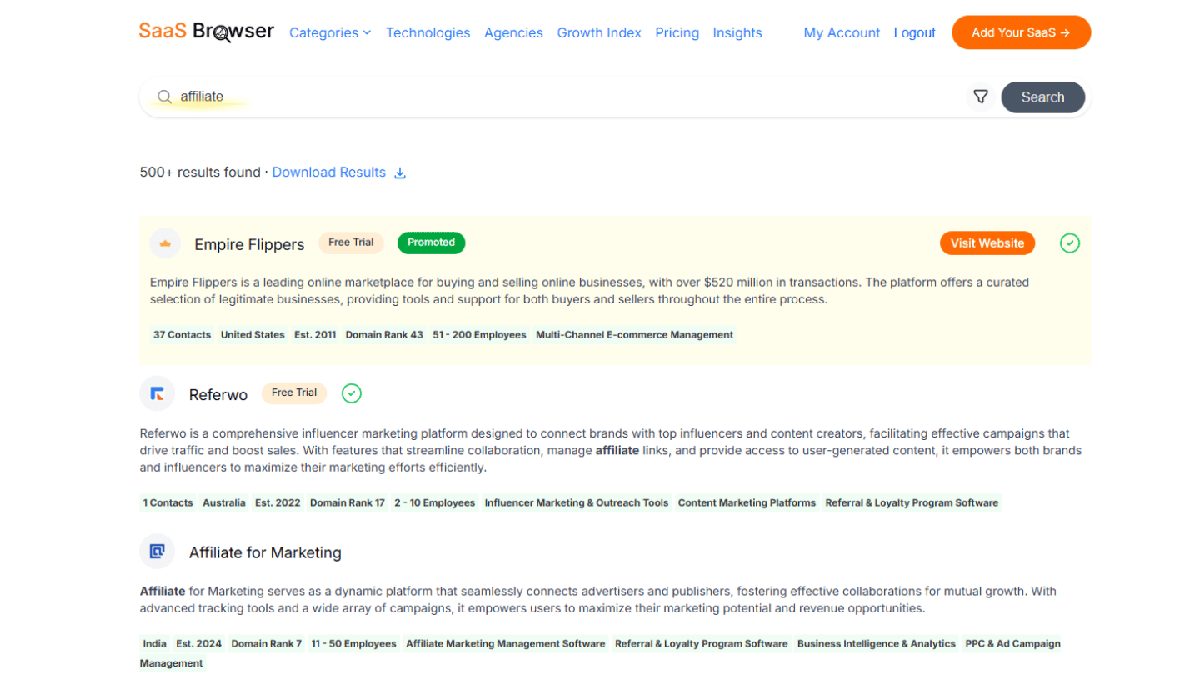
That means you can match with tools that fit your niche and your audience, before joining a SaaS reseller program that doesn’t align with your goals.
2. Referral partners in SaaS partner programs
Referral partners drive growth through something most ads can’t buy: trust.
In this type of partnership, individuals or businesses refer new customers to a SaaS vendor. That’s usually someone they already know. These partners don’t manage billing or onboarding. They simply introduce the product and let the vendor take it from there.
Referral programs are popular across different types of SaaS, especially in categories like accounting software, collaboration tools, or vertical-specific platforms. A well-run reseller program allows trusted users or consultants to earn rewards, cash, credits, or value-added services like upgrades, when their referral leads to a signup.
According to Influitive, referred customers tend to have a 59% higher lifetime value, yet many SaaS businesses still underinvest in this channel. That makes it a smart opportunity for anyone looking to break into the SaaS ecosystem without having to sell directly.
Why SaaS vendors like it
- Warm, trust-based leads often close faster
- No need to train a salesforce, just partner with SaaS users already seeing results
- Cost-effective compared to ads or outbound sales
Why referral partners like it
- No technical skills or setup needed
- Simple, scalable rewards for sharing what already works
- Great for consultants, freelancers, or current users with industry contacts
3. Authorized resellers: The classic SaaS reseller model
This is what most people picture when they hear “SaaS reseller.” An authorized reseller is a third-party company or individual that sells a SaaS product on behalf of the vendor, usually earning a commission or margin in the process.
Unlike referral or affiliate partners, these resellers are more hands-on. They’re responsible for managing the sales cycle, nurturing leads, and sometimes even closing the deal directly. In some cases, they invoice the customer themselves and provide basic onboarding or support.
This model is especially common in B2B SaaS. It’s reasonable, since buyers here often prefer working with local or industry-specific vendors. A SaaS company might authorize resellers in different countries or verticals to handle sales and support in their territory, expanding reach without building a full internal team.
Why SaaS vendors like it
- Extends their salesforce without extra headcount
- Helps them enter new markets or verticals more efficiently
- Creates recurring revenue through partner-managed accounts
Why resellers like it
- Own the customer relationship and earn higher margins
- Opportunity to bundle with other services or upsells
- More control compared to simple affiliate or referral programs
4. Value-Added Resellers (VARs) in partner programs
Not every buyer wants a plug-and-play tool. Many need help tailoring the software to their workflows, integrating it with other platforms, or training their teams. Value-Added Resellers (VARs) can provide valuable assistance here.
A VAR does more than just sell a SaaS product. They enhance it. They bundle the core software with additional services like implementation, consulting, custom development, or support. Instead of offering the product “as-is,” VARs deliver a complete solution.
This model is especially popular in enterprise and mid-market sales, where buyers are often short on time and technical expertise. A VAR might resell a CRM platform, but also handle data migration, onboarding, and ongoing optimization. It’s a natural fit for agencies, IT consultants, and managed service providers looking to grow long-term client relationships.
Why SaaS vendors like it
- VARs drive adoption by guiding customers through setup and configuration
- They reduce churn by ensuring the product is used effectively
- Strong VARs often specialize by vertical, making it easier to penetrate new industries
Why resellers like it
- Higher profit margins from selling both software and services
- More opportunities to deepen relationships with clients
- Ability to differentiate from basic resellers or affiliates
How SaaS Browser helps
With SaaS Browser, you can filter products by category, business model, and sales motion to identify those best suited for value-added partnerships.
Once you find a promising tool, you can open its dedicated SaaS company profile to explore key details, like its core features, supported use cases, and even which products it’s competing with. This helps you quickly assess whether the tool fits your value-added service offering and how it might stand out in your market.
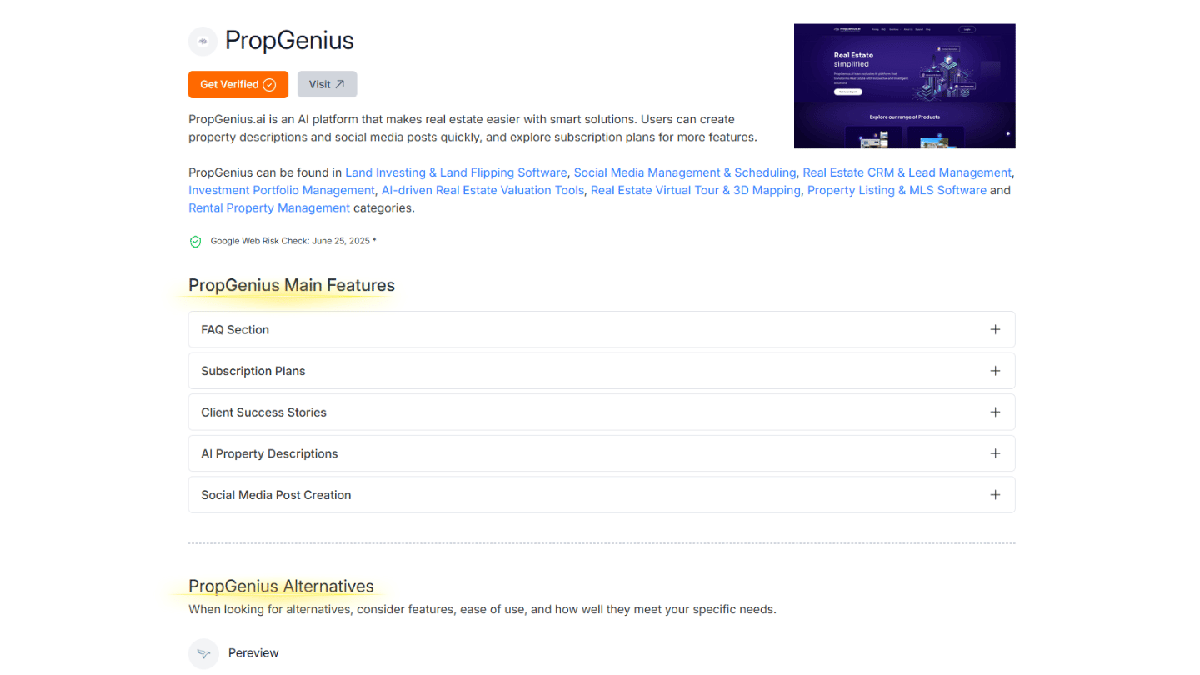
5. White-label resellers: Own the SaaS, own the brand
For some partners, reselling isn’t enough. They want full control over the branding, pricing, and customer relationship. That’s where white-label reselling comes in.
In this model, a SaaS provider allows a partner to rebrand the software and sell it under their own name, sometimes even on their own domain. The end customer might never know that another company built the tool. From setup to support, it all appears to come from the reseller.
White-label programs are especially popular with digital agencies, IT service firms, and consultants who want to expand their product line without building a new product from scratch. Instead of spending months on development, they can go to market in weeks by plugging into a mature SaaS platform and reselling it as their own.
Why SaaS vendors like it
- Rapid market expansion with minimal marketing effort
- Earn revenue behind the scenes through licensing or revenue share
- Great for tapping into verticals or markets they don’t serve directly
Why resellers like it
- Full brand control over pricing, positioning, and packaging
- Fast time-to-market without development or maintenance
- Ability to build a recurring revenue stream under their own name
6. Managed Service Providers (MSPs) as SaaS resellers
Some buyers don’t just want software. They want someone to manage it for them. That’s where Managed Service Providers (MSPs) step in.
MSPs offer fully packaged solutions where the SaaS product is just one part of a larger service. The client doesn’t buy the software directly. Instead, they pay the MSP a monthly or annual fee to handle everything. This includes selecting the right tools to set them up, maintaining them, and providing first-line support.
This model is common in industries where clients aren’t technically inclined or don’t have internal IT teams. Think small law firms, healthcare offices, or local retail chains. The MSP acts as a trusted advisor, handling updates, licenses, and user management so the client can stay focused on running their business.
Why SaaS vendors like it
- Offloads support and onboarding to partners
- Brings in steady, subscription-based revenue
- Opens access to clients who may never buy software directly
Why do resellers like it
- Offers long-term client relationships and predictable revenue
- Opportunity to bundle multiple SaaS tools into a single managed solution
- Allows you to differentiate with service, not just product pricing
7. System Integrators and complex SaaS partner models
Some SaaS products don’t live on their own. They need to be woven into a bigger ecosystem. That’s where System Integrators (SIs) come in.
SIs are technical service providers who design and implement complex solutions for clients. In the SaaS world, that often means taking a product; like a CRM, ERP, or data platform and integrating it with the client's other tools, databases, or infrastructure. The SaaS tool itself might be just one piece of the puzzle, but the SI makes the pieces fit.
These partnerships are especially common in enterprise deals or digital transformation projects, where buyers are investing in large-scale systems. The SI might handle procurement of the software, but its main revenue comes from services like integration, data migration, customization, and training.
Why SaaS vendors like it
- SIs drive the adoption of complex tools by handling setup and integration
- They bring in large enterprise clients that need high-touch implementation
- Co-selling with integrators often leads to bigger deals and better retention
Why resellers like it
- Earn revenue from consulting, not just software margins
- Gain access to high-value, project-based work
- Build long-term relationships through support and ongoing optimization
8. Consulting and solution partners in the best SaaS partner programs
Not every partner wants to sell software. Some want to help others get real results with it. That’s where consulting and solution partners shine.
These partners focus on outcomes. They may recommend a tool, help implement it, and stay involved long after the software is installed. Often, they’re marketing agencies, sales consultants, HR experts, or business ops specialists who use the software as a vehicle to deliver broader value.
Unlike basic resellers, solution partners usually work closely with clients on strategy, workflows, and performance. They may configure dashboards, train internal teams, or provide ongoing coaching. The software is just one piece of the service, they’re there to help the client succeed with it.
Why SaaS vendors like it
- Solution partners improve product adoption and reduce churn
- They bring deep domain expertise that the vendor might lack internally
- Ideal for SaaS products that require behavior change or ongoing engagement
Why resellers like it
- Create recurring income through services, not just software
- Strengthen client loyalty by being a strategic partner, not just a supplier
- Opportunity to specialize in a niche and build a reputation around results
How SaaS Browser helps
If you’re offering consulting services around a specific vertical, whether it’s sales, hiring, or marketing, SaaS Browser can help you find platforms that complement your expertise.
Filter by category or go-to-market model. Simply get the list of all available companies within your niche of interest. Here’s an example of the “Project management software” category.
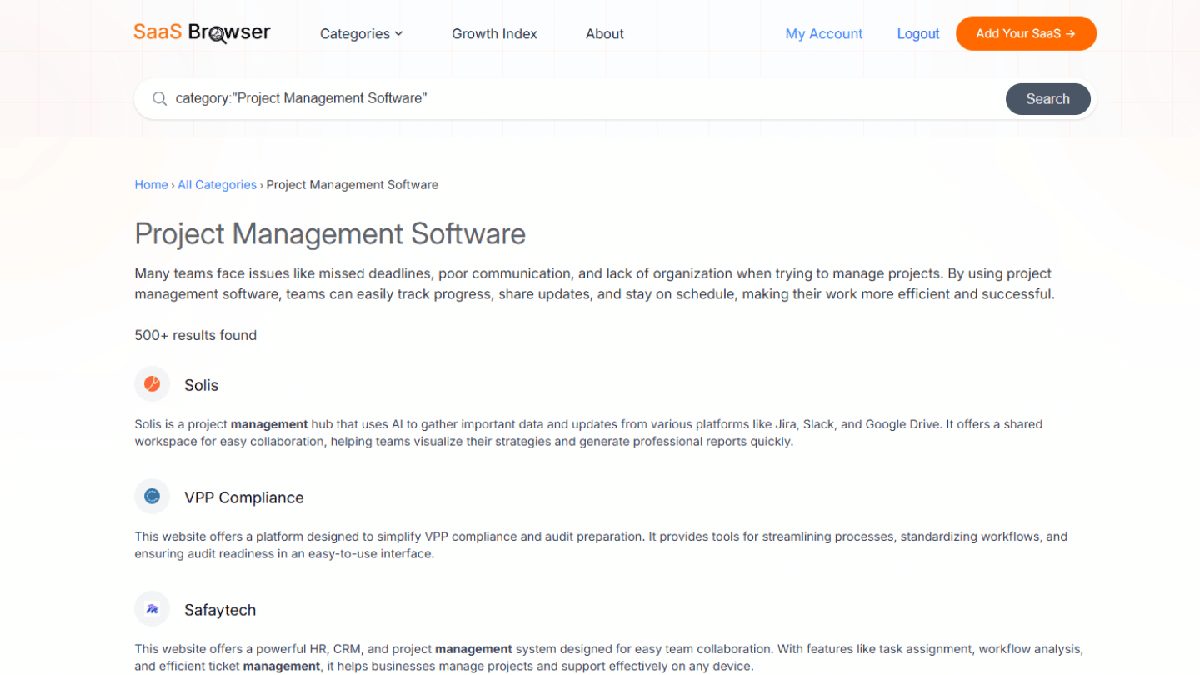
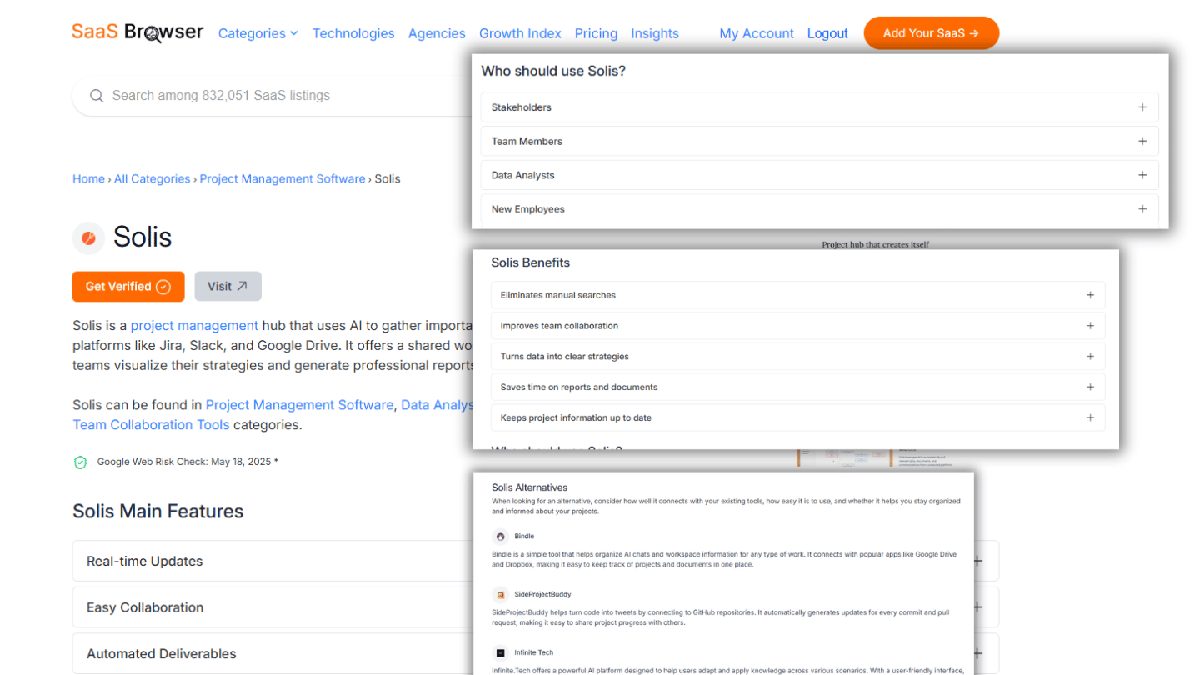
Then open individual tool profiles to assess their use cases, competitors, and growth signals. It’s a fast way to find tools that support the kind of strategic work you already do, while giving you something valuable to build around. Here we opened Solis, the first ranking SaaS for the category and found all available data.
9. Distributors & two-tier reseller programs for scale
In some partner ecosystems, the SaaS vendor doesn’t work directly with every reseller. Instead, they go through a distributor, a company that recruits and manages a network of smaller resellers on their behalf. This is known as a two-tier reseller model.
Think of the distributor as the middle layer. They handle logistics like billing, onboarding, support materials, and platform access, so the SaaS vendor can scale without managing hundreds of individual partners. The resellers, in turn, get a ready-made system for selling software, often bundled with tools and training.
This model is common in the global SaaS market, especially when vendors want to expand into new regions or target small businesses at scale. It’s also popular with marketplaces or infrastructure providers like Microsoft Azure or Ingram Micro Cloud, where multiple tools are offered as part of a centralized ecosystem.
Why SaaS vendors like it
- Scale faster without directly managing every partner
- Tap into new geographies and SMB segments efficiently
- Leverage the distributor’s infrastructure for enablement and support
Why resellers like it
- Easier entry into SaaS sales via a proven framework
- Access to bundles, pricing models, and training through the distributor
- Less overhead, many logistical tasks are handled upstream
How to choose the right SaaS reseller model
By now, you’ve seen just how many shapes a SaaS reseller relationship can take. From low-touch affiliate links to full-service managed solutions, each model has its own logic and its own sweet spot.
The right choice depends on your business, your goals, and how involved you want to be in the customer journey. Here’s a quick breakdown to help you compare.
Choosing the right model: What to consider
| Criteria | Low-touch (Affiliate/Referral) | Sales-focused (Reseller/Distributor) | Service-based (VAR/MSP/SI/Consultant) |
| Customer relationship | No ownership | Shared or direct | Fully owned |
| Revenue type | One-time or recurring commissions | Commissions or margins on licenses | Services + product revenue |
| Effort required | Low | Medium | High |
| Brand control | None | Varies (co-branded or vendor-branded) | Full (white-label) to partial |
| Best for | Content creators, influencers | Regional sales firms, small VARs | Agencies, consultants, IT providers |
| Needs technical skills? | No | Basic to moderate | Usually yes (depends on role) |
| Sales cycle involvement | None to light | Full sales process | Project-based or long-term engagement |
How SaaS Browser helps
With SaaS Browser, you don’t have to make decisions based on guesswork. You can:
- Explore 172 SaaS categories to find markets that match your domain or audience
- Filter by growth rate, business model, or pricing structure to match your capacity and goals
- Open any SaaS company profile to see its core features, key competitors, and whether it supports affiliate, white-label, or reseller program models
Whether you’re looking to go all-in on a solution partner program or just explore a few passive income streams, you’ll find smarter paths when you start with better data.