

The Software-as-a-Service (SaaS) industry has exploded globally, powering everything from workplace productivity to financial software. At SaaS Browser, we track and index SaaS companies worldwide to help founders and users discover the best tools. But which countries are producing the most SaaS companies? And what happens when we compare them not just by total numbers, but also on a per-person basis?
The Global Leader: United States
When it comes to SaaS, the United States is leading by far.
- Home to SaaS giants like Salesforce, Microsoft, Zoom, and HubSpot.
- Benefits from venture capital, deep talent pools, and mature startup hubs like Silicon Valley, New York, and Austin.
- The U.S. consistently accounts for the largest share of SaaS companies and revenue worldwide.
Other Top SaaS Countries
While the U.S. dominates, other countries are building strong SaaS ecosystems:
- United Kingdom – London as Europe’s fintech & SaaS hub.
- India – Rising stars like Zoho and Freshworks, scaling globally.
- Canada – Toronto and Vancouver attract SaaS founders and capital.
- Germany & France – Strong enterprise SaaS focus within the EU.
- Australia & Singapore – Growing ecosystems, supported by government initiatives and regional reach.
These countries regularly rank in the top 10 globally for SaaS production.
Total SaaS Companies in Top Countries
The chart below shows the absolute number of SaaS companies in leading countries.
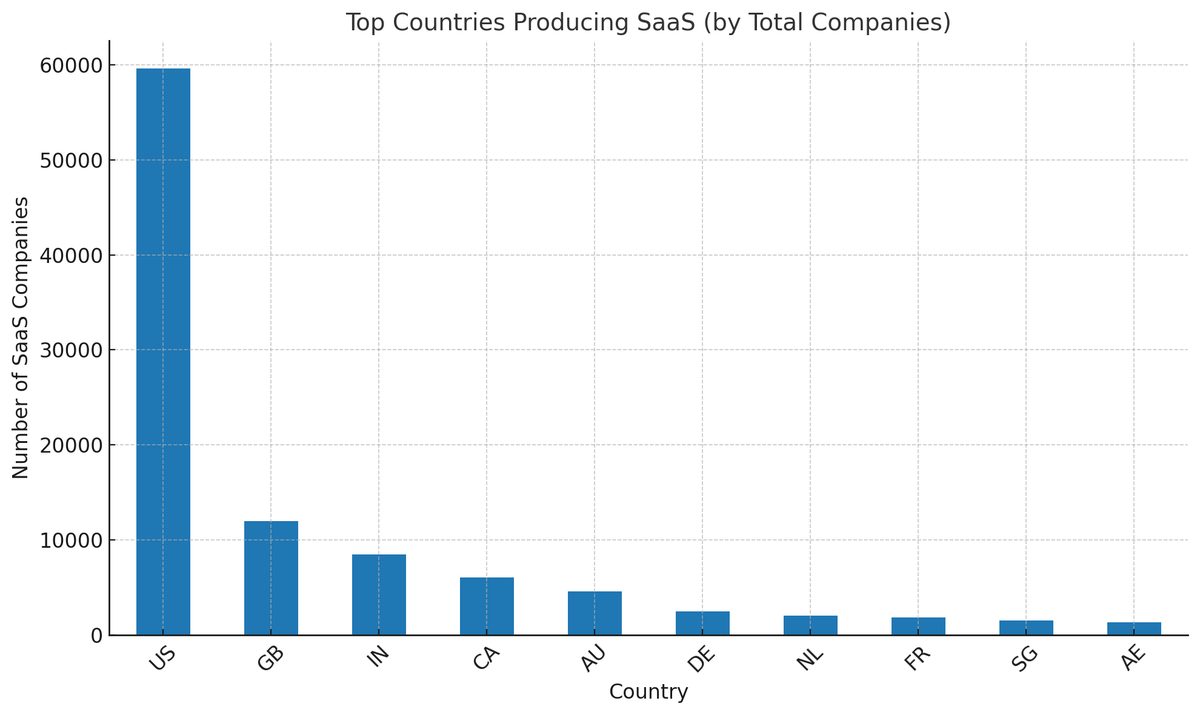
(The US leads significantly, followed by the UK, India, and Canada.)
SaaS Per Capita: A Fairer Comparison
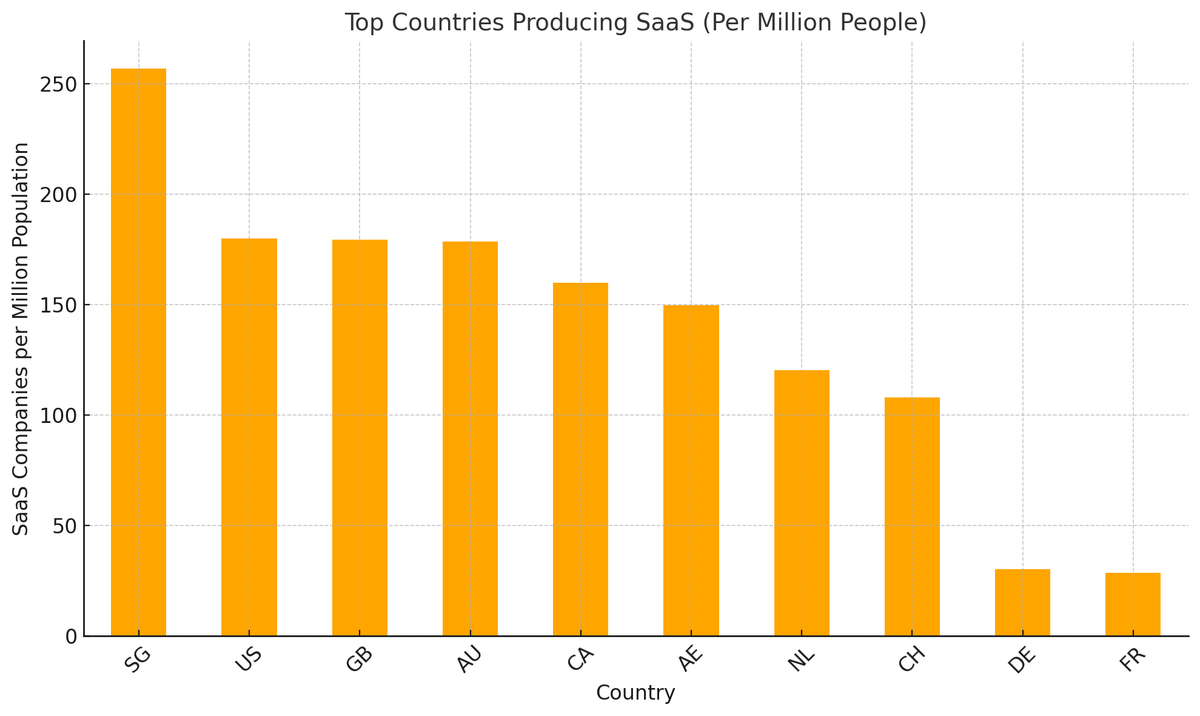
Raw company counts only tell part of the story. The United States dominates mainly because of its large population and established tech hubs. When we normalize SaaS companies per million people, the picture changes, the U.S. no longer looks as far ahead of other developed, English-speaking countries.
This perspective highlights ecosystem efficiency rather than just scale.
For example:
- Singapore, the Netherlands, and Switzerland demonstrate high SaaS density compared to population size, showing strong infrastructure and digital adoption.
- Estonia stands out through digital-first policies like e-Residency, which make it easier for global SaaS entrepreneurs to set up operations.
- Ireland benefits from favorable tax policies, the presence of multinational HQs, and easy EU market access.
(On a per-capita scale, the U.S. aligns more closely with other developed countries, while smaller nations like Singapore and Estonia stand out as innovation hubs.)
Growth Trends & Emerging Markets
- India and Southeast Asia are among the fastest-growing SaaS markets, driven by digital transformation and cost advantages.
- Venture Capital Hotspots: The U.S., UK, and India attract the majority of SaaS investment.
- Unicorn Production: The U.S. leads in unicorns, but India and Europe are catching up.
- Regional Dynamics: APAC and EMEA are becoming stronger alternatives to North America.
Caveats in the Data
No dataset is perfect, so it’s important to note:
- English-language bias: SaaS Browser currently indexes primarily English-language SaaS companies, meaning other ecosystems may be undercounted.
- Different definitions: Some rankings include only venture-backed firms, while others count bootstrapped startups.
- Rapid shifts: SaaS ecosystems evolve quickly with new funding rounds, acquisitions, and pivots.
Conclusion
The SaaS industry is no longer confined to Silicon Valley, although the United States still leads by a wide margin, other countries are quickly building their own thriving ecosystems. The UK, India, Canada, and Germany are all shaping the global SaaS landscape, while smaller nations like Singapore and Estonia prove that size doesn’t limit innovation when measured on a per-capita basis.
As the market continues to expand, new players will rise, driven by access to talent, venture capital, and government support. For founders and investors, this global spread of SaaS means opportunity is everywhere, not just in the U.S. To explore thousands of SaaS companies by country, category, and growth stage, visit SaaS Browser.