

How much is a SaaS company really worth?
It’s a simple question with a thousand messy answers. One founder’s “high-growth rocketship” is another investor’s “overpriced spreadsheet.” And in 2025, when AI features are slapped on everything and metrics can be… let’s say interpreted, cutting through the noise matters more than ever.
This guide is here to help you do exactly that break down how SaaS companies are actually valued today, what frameworks and ratios still hold up, what’s changed, and how tools like SaaS Browser can help you evaluate with clarity instead of guesswork.
SaaS evaluation: How to value a SaaS business today
In 2025, the SaaS landscape is flooded. According to Exploding Topics, the number of SaaS products has grown past 50,000 public-facing tools globally, with private databases like SaaS Browser tracking over 800,000 across micro-niches, verticals, and use cases.
For buyers, that’s a jungle of similar-sounding tools with subtle differences. For investors, it’s a challenge to separate scalable products from glorified side-projects.
The stakes are high: value the wrong SaaS company, and you overpay for churn. Miss a great one, and someone else grabs it at 4× ARR.
That’s why this guide exists.
We’ll walk you through the key evaluation criteria investors and buyers actually use today, metrics like NRR, LTV: CAC, burn multiple, and the all-important Rule of 40. We’ll also explore real-world SaaS valuation frameworks and show you how to benchmark companies in saturated vs. underserved markets.
Why SaaS valuation matters more than ever
Unlike physical assets or traditional businesses, most SaaS companies don’t come with a clean P&L (Profit and Loss statement) and a predictable cash flow model. Their value hides in metrics, business model structure, and how efficiently they turn customer acquisition into sustainable MRR (Monthly Recurring Revenue).
That’s why a modern SaaS valuation requires more than slapping a revenue multiple on last month’s ARR (Annual Recurring Revenue). You need to understand why a certain SaaS product grows while others stall. You need to measure not just revenue, but retention. Not just growth, but efficiency.
The problem? Private SaaS startups rarely have public comps, audited financials, or liquidity events. Valuing a traditional business relies on EBITDA (Earnings Before Interest, Taxes, Depreciation, and Amortization) or asset value. But the value of a SaaS company is shaped by different forces: churn, product stickiness, CAC payback, and network effects.
That’s why both buyers and investors are adopting sharper evaluation criteria, frameworks that go beyond surface-level numbers to evaluate SaaS companies holistically.
A solid SaaS evaluation checklist today includes everything from the quality of recurring revenue, to the resilience of the business model, to the defensibility of the tech stack. Without this, you're flying blind.
And in a market where everyone has a “revolutionary” SaaS application, being able to confidently evaluate a SaaS vendor can be the difference.
SaaS metrics that matter in every valuation
Whether you're trying to value a SaaS company for acquisition or just comparing providers, the metrics you focus on can impact your decision in a big way. These aren’t just numbers, they’re signals that reveal how sustainable the SaaS business model really is and whether the product has legs in an increasingly crowded SaaS market.
Let’s break down the first three metrics that are immensely important for every smart SaaS evaluation:
1. ARR & MRR: The foundation of every SaaS valuation
ARR (Annual Recurring Revenue) and MRR (Monthly Recurring Revenue) are the baseline for assessing the value of a SaaS business. These two metrics track the predictable income from subscriptions. This makes them the core of any serious SaaS valuation.
Why they matter:
- They reflect the strength of the underlying SaaS business model.
- They serve as the starting point for calculating valuation multiples.
- They reveal growth velocity, an essential signal in early-stage SaaS startups.
A new SaaS product with $1M in ARR growing at 80% is often valued more highly than a $5M tool growing at 10%, because growth potential weighs heavily in most valuation methods. According to SaaS Capital, public SaaS companies trade around 6× to 10× ARR, while private ones usually fall in the 3× to 5× range.
2. Net Revenue Retention (NRR) & churn: Your silent growth engine
High revenue growth means little if customers don’t stick around. That’s where Net Revenue Retention (NRR) becomes a critical part of any SaaS evaluation checklist.
NRR tracks how much revenue you retain and expand from existing users after churn, downgrades, and upsells. A strong NRR (over 100%) means your product is sticky, and that growth is compounding.
Why NRR and churn are key:
- They reflect user satisfaction and true product-market fit.
- They directly influence the value of a SaaS company by reducing revenue volatility.
- They’re one of the most cited metrics in SaaS company valuations.
If churn is too high, it signals deeper problems in the SaaS application—either the wrong audience, weak onboarding, or insufficient long-term value. And in valuation terms, that can drag even a high-revenue product down by multiple turns.
3. LTV, CAC & Payback Period: The core unit economics
You can’t evaluate SaaS properly without looking at the economics behind each customer. That means focusing on Customer Acquisition Cost (CAC), Lifetime Value (LTV), and the CAC payback period.
This trio of metrics shows whether your customer acquisition strategy is sustainable—and whether growth is truly scalable.
What to look for:
- A healthy LTV:CAC ratio (around 3:1) means your sales and marketing are efficient.
- A CAC payback period under 12 months suggests faster ROI and lower cash risk.
- A rising LTV over time shows strong customer engagement and expansion potential.
Together, these metrics are essential to any smart SaaS evaluation. They tell investors and acquirers if your startup is burning money to grow, or building a profitable flywheel that compounds over time.
4. Gross margin: The silent signal of SaaS quality
You can have growing revenue, decent retention, and even solid customer acquisition, but if your gross margin is thin, the foundation starts to crack.
For most SaaS platforms, gross margin should land in the 70–90% range. That’s the advantage of software: once it’s built, the cost to serve each new customer is minimal. However, when we see margins dipping below 60%, it often signals hidden costs, such as heavy service components, infrastructure dependencies, or under-optimized tech stacks.
Why this metric matters to SaaS company valuations:
- It tells you how much of the recurring revenue actually contributes to growth or profit.
- It helps distinguish between true SaaS apps and service-heavy hybrids.
- It’s a core filter used in both private equity and B2C SaaS evaluations.
Investors who prioritize valuation methods that account for long-term sustainability will often adjust down the multiple if gross margins don’t meet benchmarks, especially in smaller companies that can’t offset inefficiencies at scale.
5. The Rule of 40: Balancing growth and profitability
Here’s a reality check: High growth can mask bad business fundamentals. That’s where the Rule of 40 comes in—a simple benchmark that adds revenue growth rate and profit margin together. If the sum is 40% or more, you’re in solid territory.
Why it’s a staple in modern SaaS evaluation templates:
- It lets you compare startups at different stages using one clean formula.
- It encourages operational discipline, even in a “growth at all costs” culture.
- It levels the field across different SaaS business models (freemium, enterprise, etc.).
For example:
- A company growing at 50% annually with a -10% margin? Rule of 40 = 40 — looking good.
- Another growing at 25% with 15% margin? Also solid.
- But if your SaaS startup is growing at 15% and losing 30%? That’s a red flag.
Especially in today’s SaaS funding climate, where capital is more selective, the Rule of 40 serves as a quick sanity check for both investors and founders alike.
6. Burn multiple: How efficiently are you buying growth?
Coined by investor David Sacks, the burn multiple measures how much cash you're spending to generate each new dollar of net ARR. The formula is simple:
Burn multiple = Net cash burned / Net new ARR
This metric has become one of the primary factors in how experienced buyers and VCs evaluate SaaS startups, because it reveals whether your growth is healthy or artificially propped up by overspending.
What to aim for:
- <1× = Elite efficiency (rare, but magical)
- 1–2× = Acceptable, especially in early-stage growth
- >2× = Risky or wasteful (expect valuation discounts)
For anyone trying to evaluate SaaS businesses in a competitive landscape, the burn multiple helps answer this: Is this startup growing because it’s good, or because it’s burning through investor money?
When combined with other software evaluation criteria like retention and LTV: CAC, burn rate multiple helps create a full picture of scalability and capital efficiency, especially important for those looking to optimize SaaS portfolios.
SaaS valuation frameworks: The four most-used models
Understanding the value of a SaaS company isn’t just about looking at metrics, it’s about applying the right framework to interpret them. Whether you're acquiring a new SaaS business or benchmarking a competitor, these are the four valuation models most commonly used in 2025:
- Revenue multiples
The default for fast-growing SaaS businesses, especially those with strong ARR. Public companies average 6–8× ARR, while private companies typically see 3–5×, depending on size, growth, and retention. This model works best when profitability is still emerging, but growth is strong. - EBITDA / SDE multiples
Used more often for profitable, low-growth SaaS or smaller companies. EBITDA (Earnings Before Interest, Taxes, Depreciation, and Amortization) or SDE (Seller’s Discretionary Earnings) multiples reflect actual cash flow, common in bootstrapped or service-heavy SaaS, where recurring revenue is stable but scale is limited. - Discounted Cash Flow (DCF)
Ideal for later-stage businesses with predictable financials. It models future cash flows and discounts them to present value. While precise, it’s less useful for early-stage startups due to high forecasting uncertainty. - Scenario-based valuation (First Chicago Method)
Blends upside, base case, and downside scenarios. Especially helpful when evaluating SaaS startups with uncertain outcomes—offering a probabilistic view of what the business might be worth depending on execution and market forces.
Each model has its place. The key is to match the framework to the company’s growth profile, business model, and financial data maturity. For newer SaaS applications, revenue multiples tend to dominate, but smart investors often run multiple models before making a call.
SaaS evaluation criteria: What experienced buyers and investors look for
While metrics like ARR and LTV tell you how a SaaS company is performing, they don’t tell you why or how it will perform in the future.
1. Market niche and saturation: Is this SaaS solving a unique problem?
Before you value a SaaS company, you need to understand the market it's playing in. Are they operating in a saturated category like AI with thousands of competitors? Or are they carving out a distinct niche?
SaaS Browser gives you live visibility into market saturation across thousands of micro-categories.
Here’s how:
- Use category-level filters (e.g., “AI-powered Ad Creatives” or “Remote Team Collaboration Tools”) to see how many SaaS companies are already operating in that space.
- Cross-filter by business model (freemium, subscription, enterprise), minimum domain ranking, or target geography to dig even deeper.
- Quickly spot whether the market is overrun or underpenetrated.
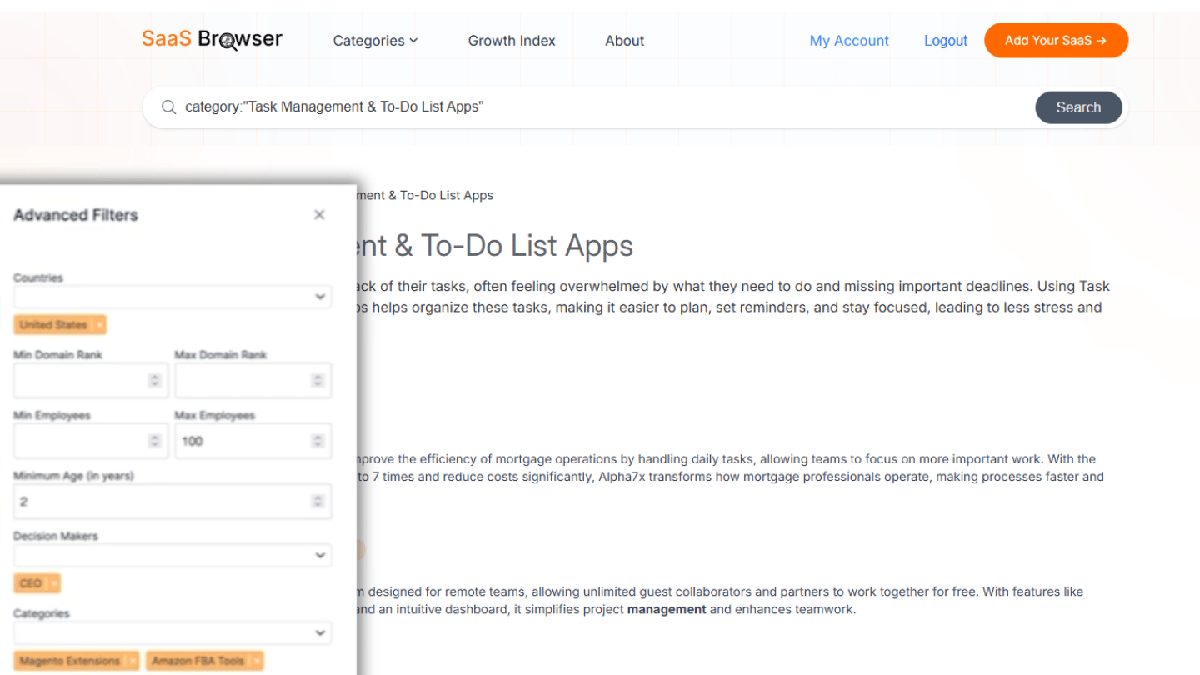
For example, if you’re evaluating a new SaaS product in "Affiliate Management Software," SaaS Browser might show you 2,000+ competitors. But if you filter for B2B, mid-market, launched post-2022, you might discover only a dozen direct competitors. That’s a more viable opportunity, and that context changes how you value the company.
This kind of niche analysis would normally take hours of manual research. SaaS Browser does it in seconds. That insight helps you determine if the product deserves a premium valuation multiple or needs a discount for market crowding.
2. Product positioning: Who is this tool built for and is it clear?
Even in a crowded market, a SaaS product with sharp, well-aligned positioning can outperform slower competitors. But most investors and buyers don’t have time to click through 20 company websites to assess who the product is really for.
With SaaS Browser, you can see positioning and audience fit on the SaaS profile itself. Each product listing includes:
- A short, curated explanation of who the tool is perfect for (e.g. solopreneurs, small agencies, enterprise HR teams)
- Key features and benefits, written clearly to reflect the product’s core value
- A list of comparable and alternative tools in the same niche for benchmarking and deeper evaluation
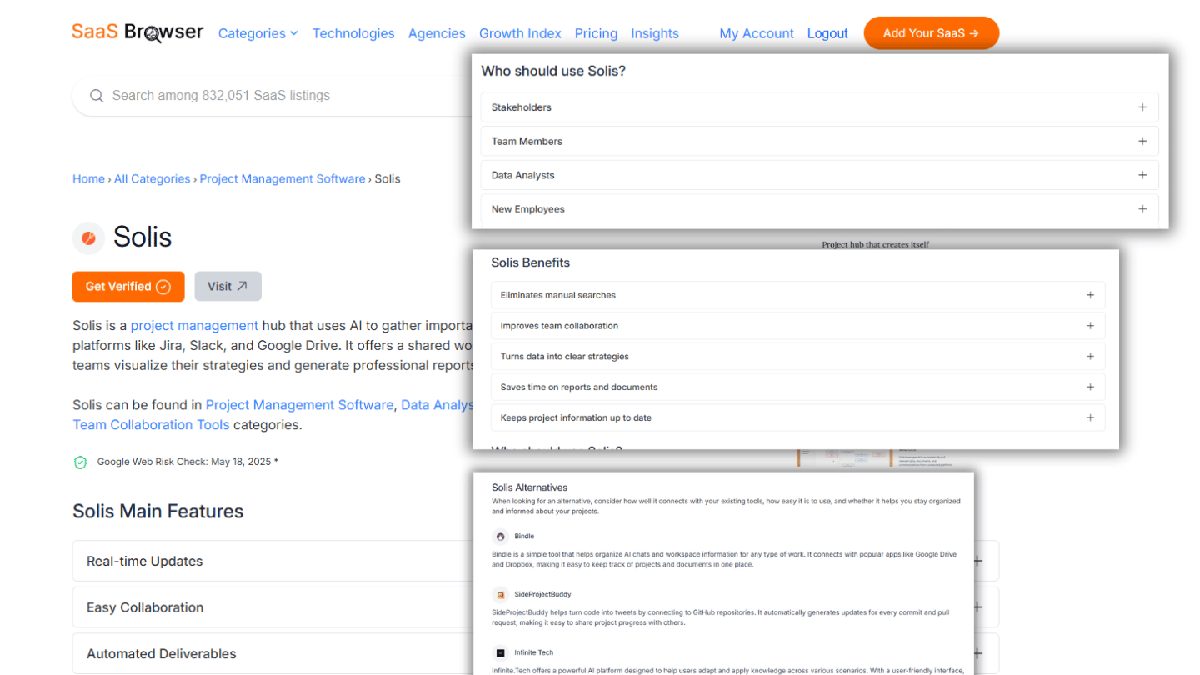
This lets you evaluate at a glance:
- Whether the product understands its ICP (ideal customer profile)
- Whether it’s positioning toward a crowded or underserved segment
- Whether it's differentiated or just echoing the same benefits as everyone else
By seeing who a tool is actually built for, you avoid wasting time on generic solutions and focus only on products with clear market fit.
3. Tech stack and infrastructure: How stable and scalable is the product?
Every SaaS application relies on an invisible foundation; its tech stack. And that foundation matters more than most realize. The tools, frameworks, and services a product is built on can impact everything from performance and uptime to long-term scalability and maintenance costs.
With SaaS Browser, this layer isn’t hidden. Each SaaS profile includes a breakdown of the technologies used in development, so you can:
- Instantly identify which frameworks, libraries, or services (e.g., React, Next.js, AWS, Firebase) are powering the product
- Spot reliance on fragile infrastructure or deprecated tools that may raise long-term risk
- Gauge whether the platform is built to scale or built to break
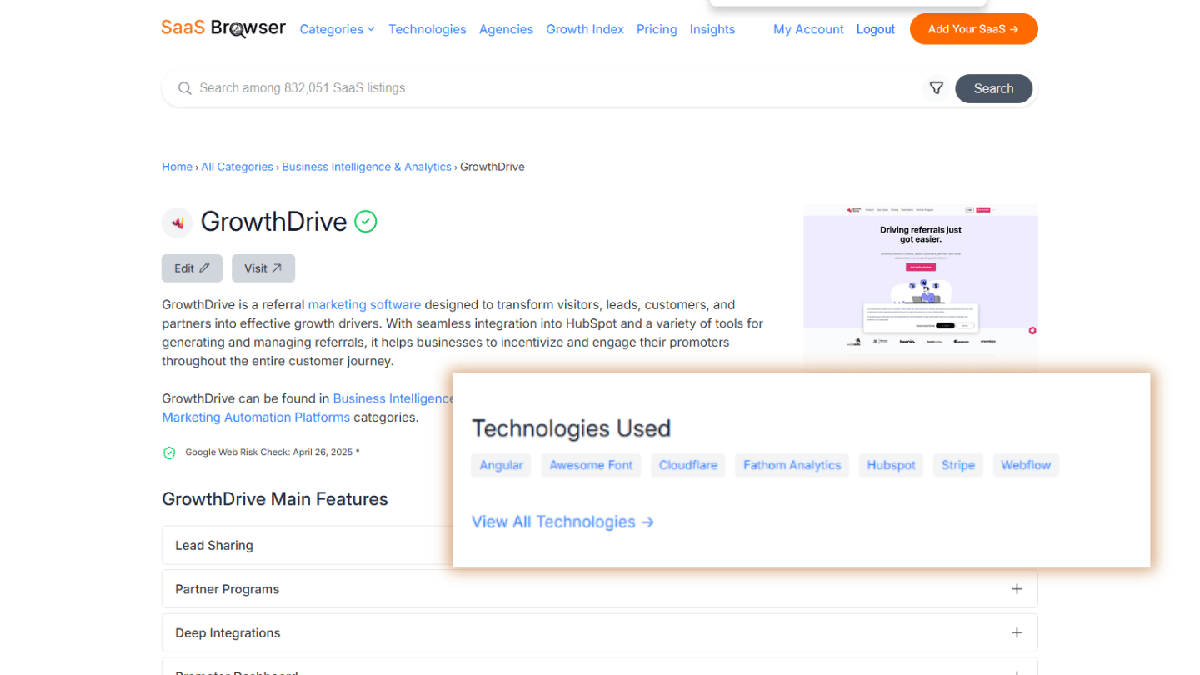
This is especially useful for:
- Technical investors who want to quickly assess software stability and DevOps overhead
- Non-technical buyers who need to avoid tools with brittle backend setups or excessive maintenance needs
- Anyone vetting smaller SaaS startups, where the tech stack can hint at whether the product was built by experienced engineers or rushed out by a solo founder
This insight also helps you estimate the resource cost of future improvements or integrations. If a product is built on solid, modern infrastructure, that’s not just a technical detail, it’s a valuation input.
4. Traction transparency: Is this company active, trusted, and real?
In early-stage SaaS, traction isn’t always visible in the financials. But signs of momentum are everywhere (if you know where to look). And SaaS Browser centralizes those signals into one view.
Every product listing includes rich context like:
- Year established and founding team details
- Business address where you can find them
- Social media links (LinkedIn, X/Twitter, YouTube, etc.) and activity levels
- Business address and contact information
- Niche tags and trust signals like market category, audience, or even SOC 2 status, if available
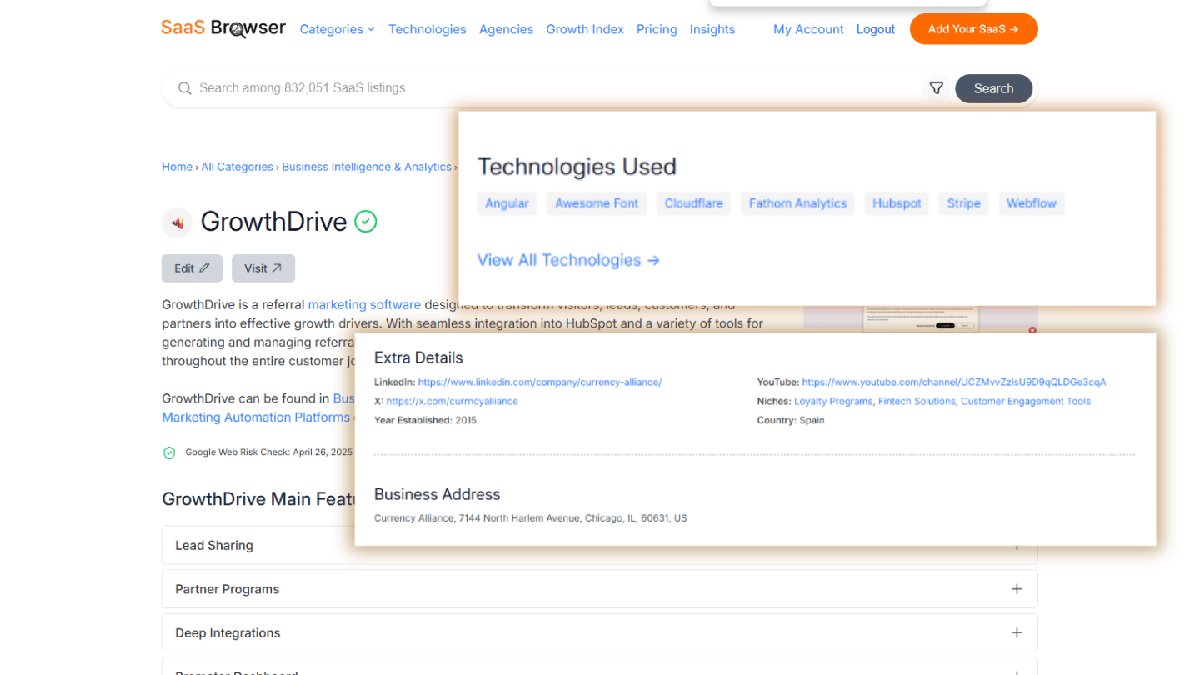
This lets you quickly evaluate:
- Whether the team is active and still shipping updates
- If the product is connected to a real business or just a side project
- How easy it is to initiate contact for a partnership, investment, or acquisition inquiry
For investors, this is gold. You can discover promising new SaaS businesses before they hit mainstream deal platforms, then verify their presence and reach out directly using verified contacts.
For SaaS buyers, it builds trust faster. You’re no longer guessing whether a product is legitimate. You can see who’s behind it, how long it’s been live, and how actively they engage with their audience. This makes it easier to choose the right provider and avoid abandoned apps with no support or development roadmap.
5. Founder accessibility: Can you start a meaningful conversation?
One of the most frustrating parts of evaluating early-stage SaaS is this: you find a promising product… but there’s no clear way to reach the founder.
That’s a deal-breaker for investors, who need fast, direct communication. It's also a trust blocker for buyers who prefer products backed by responsive teams.
SaaS Browser solves this with verified contact access. Every profile includes:
- Direct email addresses for founders and key decision-makers
- LinkedIn profiles for outreach and credibility checks
- Role-based tags (CEO, CTO, CMO) to help you contact the right person
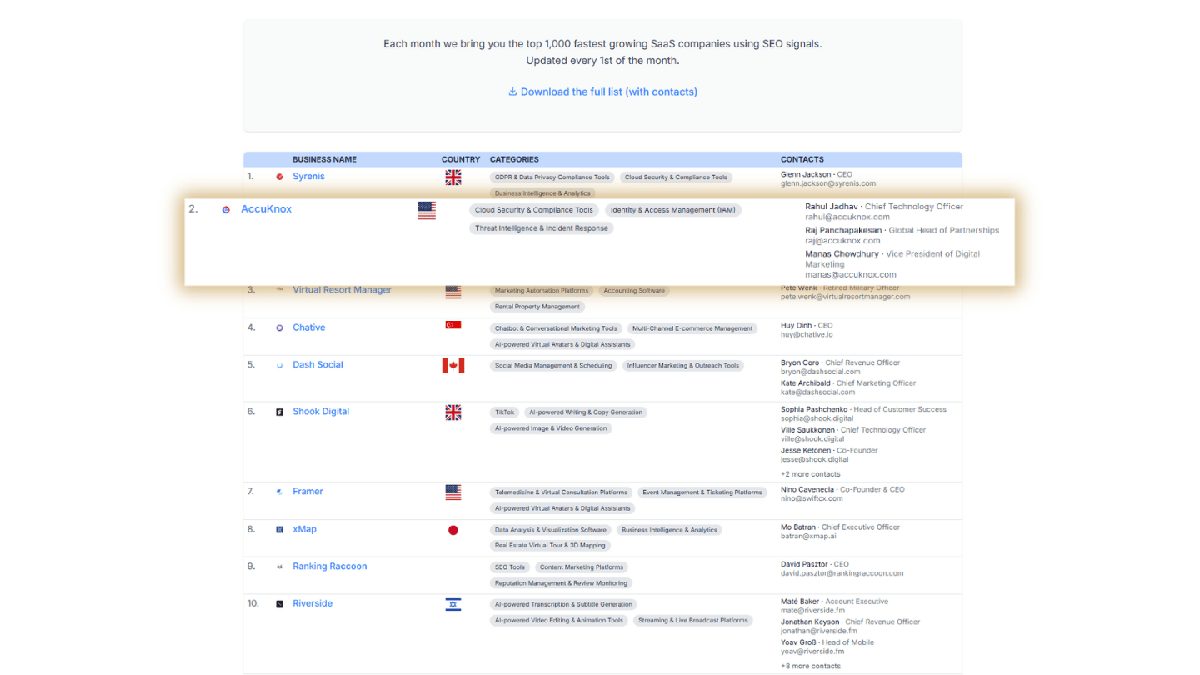
This streamlines the valuation process and speeds up real-world deal flow. If you're a buyer with a shortlist of tools or an investor looking to qualify acquisition targets, SaaS Browser eliminates the guesswork. You can:
- Reach out for demos, trials, or custom pricing
- Start private deal conversations before others even know the tool exists
- Qualify founders based on communication speed and clarity, an underrated indicator of execution quality
In a world where many SaaS products are founder-led, accessibility isn’t a nice-to-have. It’s part of how you evaluate the company itself.
6. Competitive moat: What protects this SaaS from being replaced?
Every SaaS business competes in a dynamic environment. What gives one tool staying power while others fade? That’s the question behind moat analysis, and it's a critical part of valuing a SaaS company.
SaaS Browser helps you assess the moat through side-by-side insights:
- View a product’s core features and compare them to alternative software in the same category
- Explore what benefits they emphasize: speed, integrations, pricing, AI, security, etc.
- See how differentiated the positioning is across hundreds of other SaaS solutions in the same niche
This is incredibly useful when you want to:
- Benchmark a SaaS provider: Is it offering anything competitors aren't?
- Avoid “me too” products: Tools that just copy others with minor tweaks
- Spot unique strengths: Like a deep API, a proprietary dataset, or vertical-specific workflows
For investors, this helps determine whether a product has true defensibility, or whether the next well-funded team could replicate it in six months. For buyers, it’s how you pick the right SaaS for your business, not just the one with the loudest marketing.
In both cases, SaaS Browser provides the visibility and structure to turn vague impressions into real, comparative analysis, so you can focus on what matters most: long-term value.
SaaS Evaluation Checklist for Investors & Founders
If you're looking to evaluate a SaaS company, whether to buy, invest, or benchmark, this checklist gives you a structured, no-fluff path. Each item touches on key SaaS valuation metrics and qualitative insights that separate high-potential products from average tools.
Use this as your practical guide before making any move:
- Check ARR growth and retention. Is Annual Recurring Revenue (ARR) growing quarter-over-quarter? Is churn under control? Strong net retention (>100%) is a green flag—flat growth or high churn signals product-market misalignment.
- Evaluate the LTV: CAC ratio. Is the Customer Lifetime Value (LTV) at least 3× the Customer Acquisition Cost (CAC)? That ratio suggests scalable unit economics. If it’s below 3:1, the business may be spending too much on sales and marketing to sustain growth.
- Calculate the Burn Multiple. Burn multiple = Net burn / Net new ARR. A burn multiple <1 is exceptional; 1–2 is good; 2–3 is watchable. Anything over 3 means the startup is burning too much relative to growth, common in high-spend, low-focus models.
- Apply the Rule of 40. Add revenue growth% % + EBITDA margin%. If the result is 40% or higher, the SaaS business is balancing growth and profitability well. This is a must-check for mature SaaS companies.
- Benchmark valuation multiples. Use public SaaS data or private comps from tools like SaaS Browser to check if the business is in the right valuation range for its stage, vertical, and growth. Early-stage? Expect 3–5× ARR. High-growth B2B SaaS? Possibly 8× or higher.
- Assess competitive saturation. Are there 5 similar tools, or 500? Use SaaS Browser’s market filters to search by category and compare feature sets, use cases, and positioning. A saturated category isn’t a dealbreaker, but a differentiated moat becomes essential.
- Run team and tech due diligence. Who built this—and how? SaaS Browser shows the tech stack, year founded, and team profiles. Look for modern infrastructure, active founders, and products that aren't duct-taped together behind the scenes.
Evaluate a SaaS company with confidence
Whether you're looking to invest in a SaaS startup, acquire a growing SaaS business, or simply choose the right software provider for your company, what separates a smart decision from a risky one is the ability to evaluate with structure, clarity, and speed.
That’s where a tool like SaaS Browser comes in. You can supercharge your evaluation with SaaS Browser:
- Filter by niche, tech stack, go-to-market model, or pricing structure to instantly narrow your options
- Explore alternatives with real-time comparison, see who’s doing it better (or worse)
- Scan product benefits and ideal customer profiles to gauge positioning and market fit
- Review development stacks to assess scalability and engineering complexity
- Get direct contact info for founders and teams so you can act before the rest of the market catches up
In short, SaaS Browser turns SaaS due diligence into a few clicks, whether you're building, buying, or investing.
And remember: the best decisions aren’t made with gut instinct alone. They're made with the right framework, metrics, and visibility.