

Back in 2014, AI-powered software was barely beyond the realm of research labs and nascent B2B tools. Yet the number of AI SaaS apps on the market has surged an incredible 103,844% from 2014 to 2024. That’s thanks to AI leaping into mainstream tools, (over)heated VC interest, and plug-and-play AI APIs from the likes of OpenAI and Google Cloud.
In this article, we’ll dig deep into the meteoric rise of AI SaaS apps and explore the key drivers of this brand-new sector. We’ll uncover why specific verticals like business intelligence and workflow automation are leading the charge. We’ll also examine the sustainability of this growth and what we can anticipate over the next decade.
AI SaaS Apps Hit Record High in 2024
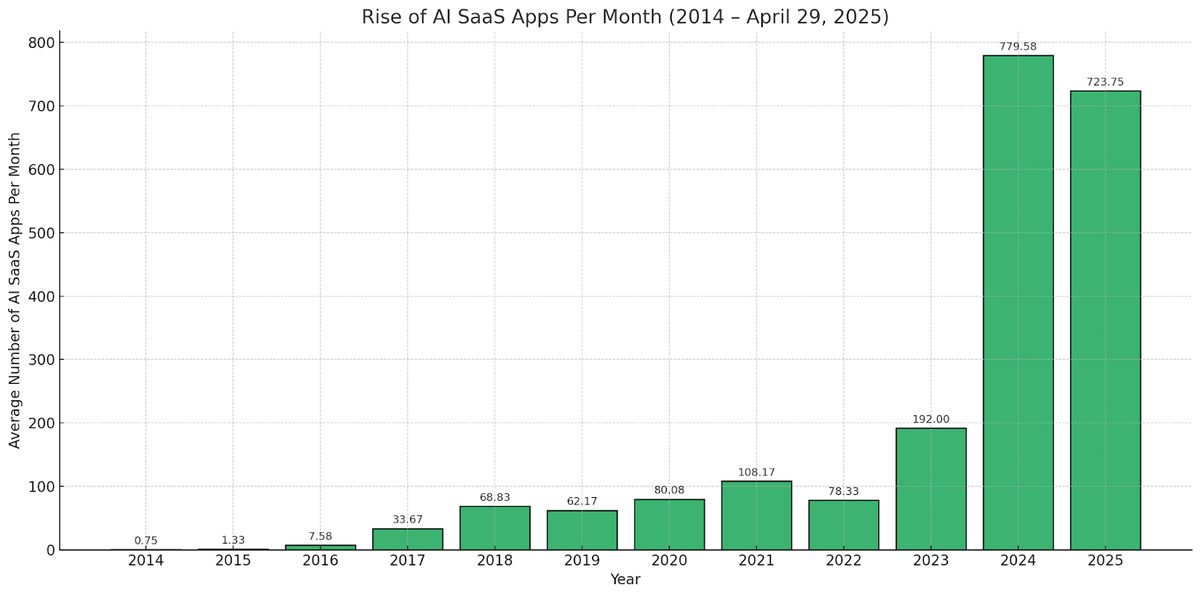
Fig. 1: Data from Saas Browser. The number of AI SaaS apps refers to websites classified as SaaS by our machine learning model. This means they use the .ai TLD (Top-Level Domain) and also display SaaS-like features, such as pricing pages, clear value propositions, a 'book a demo' feature, login, and more.
We pulled data from SaaS Browser’s comprehensive database of global SaaS companies to better understand the rise of AI apps. And what we discovered was truly mind-blowing.
As you’ll see in Fig. 1 above, the AI apps boom kicked off in 2023 with a 145% rise YoY compared to 2022 and an overall rise from 940 to 2304 apps. This was followed by a 306% YoY jump in 2024 to reach a total of 9355. 2024 accounts for almost 44% of the AI SaaS applications launched in the last decade. In 2024 alone, almost as many apps were built and launched as in the previous nine years. Figures for 2025 are only currently available to the end of April, but initial indications show growth almost consistent with 2024 for the first 4 months of the year.
So What’s Driving the Boom in AI SaaS Apps?
Effortless Generative AI
2022 was a big year for AI SaaS with the release of Stable Diffusion in August and ChatGPT in November. Now, anyone could use these simple tools to create images, write text, analyze data, or even code.
Plug-and-Play AI APIs
Hot on their heels came a wave of activity with developers embedding large language models and diffusion models straight into SaaS apps. What used to take months could now be done in days. Startups no longer need to train foundation models from scratch. Instead, they could simply tap into open-source repositories from Hugging Face, model hubs on AWI, or APIs from OpenAI. Small teams could suddenly create and launch a SaaS startup almost effortlessly.
At SaaS Browser, we also utilize a substantial amount of OpenAI’s API to generate profiles about SaaS. If you have a profile for your SaaS on SaaS Browser, you can verify it and update the information.
Venture Capital Funding Frenzy
Sharp-eyed VCs were quick to realize the potential of this new sector, pouring billions into AI Saas startups over the last two years. Venture funding for AI-related companies surpassed $100 billion in 2024, with some seed rounds rivaling Series B in size.
ChatGPT, in particular, made AI look more tangible and practical than previous hype cycles. Consumers and businesses could now interact directly with AI, and investors could see the benefits in real-time.
AI Washing
Just as in the dot-com bubble of the late 1990s, some companies are leveraging AI to boost their valuation or make their offerings more appealing to consumers and investors. It’s a marketing tactic used to exaggerate the centrality of AI to their product, which likely skews annual growth figures.
Part of the problem is the vague definition of AI itself, which leaves ample room for interpretation. For example, using an AI tool to generate product ideas or analyze customer feedback is very different from an automated customer support bot.
For example, many search features on websites, which have existed for decades, now rebrand themselves as an “AI-search”, even though their underlying technology hasn’t changed or been upgraded. The best search features these days utilize a vector search engine, which involves converting text into vectors, or numerical representations of your search query.
This is considered “artificial intelligence” because it utilizes some form of machine learning; however, this technology has been around for many years. Nevertheless, many websites are relabeling it as “AI-search” to capitalize on the trend and appear more appealing to consumers.
Consumer and user behaviors constantly change over time, and it will be interesting to see whether consumers will notice this AI washing over time.
However, for the sake of this report, it's essential to note that simply because a domain name uses the .ai top-level domain, it does not necessarily mean that the application is utilizing AI; it could simply mean they are capitalizing on the hype.
Fastest-Growing Categories for AI SaaS Apps
Drilling deeper into our data, we’ve highlighted the top ten categories for AI SaaS applications currently on the market in Fig. 2 below. Leading the pack in 2024 were Business Intelligence and Analytics apps with 2237 apps, followed by Smart Contract Development tools at 1476 and Data Labelling & Annotation with 1183.
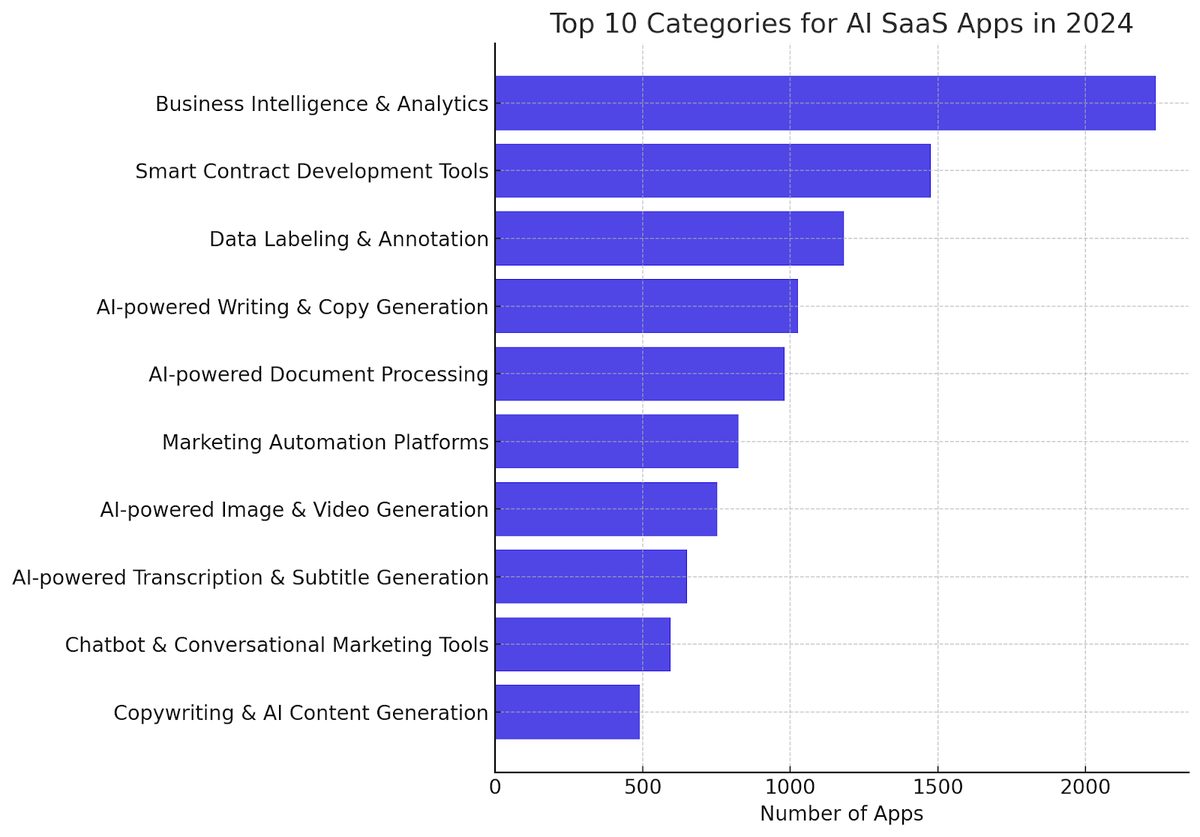
Fig. 2: Data from Saas Browser
In Fig. 3 below, you’ll see growth by category mapped out over the last three years for the top six categories. All categories experienced triple-digit to quadruple-digit growth between 2022 and 2024.
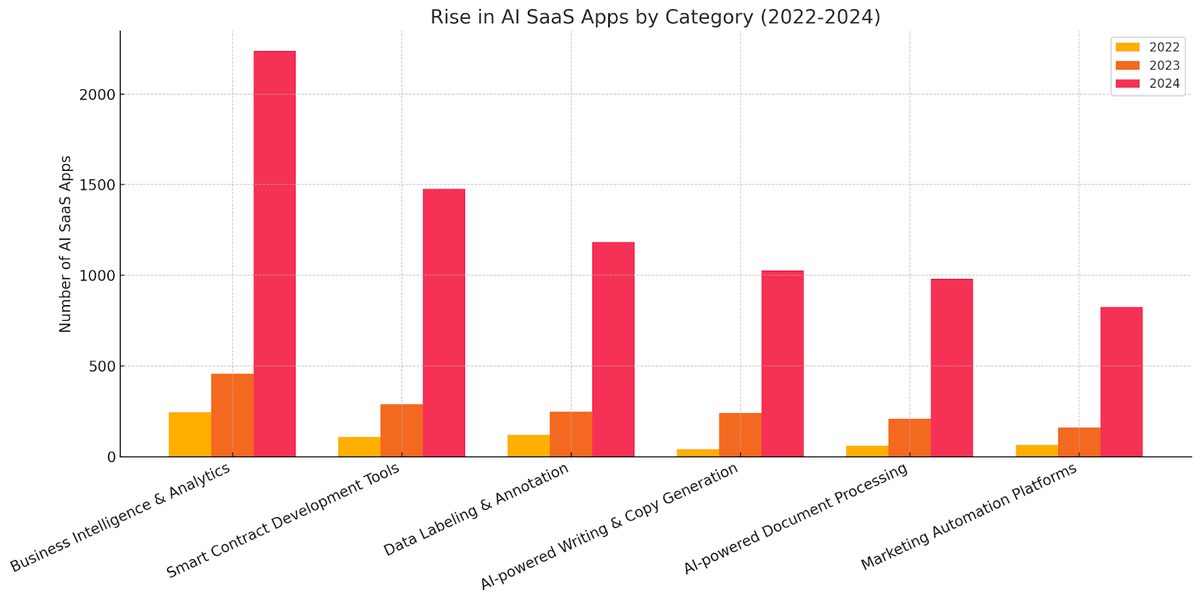
Fig. 3: Data from Saas Browser
Business Intelligence & Analytics
This category leads the boom in AI SaaS apps by overall count, with an impressive 813% growth between 2022 and 2024. Business Intelligence tools need to make sense of data, and that’s where they fit perfectly with modern AI capabilities.
AI copilots like Power BI or Tableau allow you to plug in basic queries like "What are churn rates for Q2?" and get immediate answers. And that translates into better decision-making backed up by actual data.
Data Labelling & Annotation
Data Labelling & Annotation apps increased 886% from 2022 to 2024, from 120 to 1183. These tools are invaluable given that AI models have an insatiable appetite for high-quality training data.
They can label, clean, and verify datasets with lightning speed and precision, often aided by human-in-the-loop input for even greater accuracy and relevance. These AI-assisted tools are especially relevant for industries such as self-driving vehicles for object detection, medical imaging for tumor identification, and retail for applications like shelf monitoring and pricing automation.
Workflow & Content Creation Automation
AI-powered Document Processing apps grew 1535% from 2022 to 2024, while AI-powered Writing & Copy Generation showed 2465% growth.
Document Processing tools help extract figures and key data from invoices or forms, while AI-powered Writing apps use Generative AI for almost instant content creation. It’s easy to see why businesses are jumping on apps that streamline workflows and enable leaner operations.
USA, UK & India Dominate AI SaaS App Development
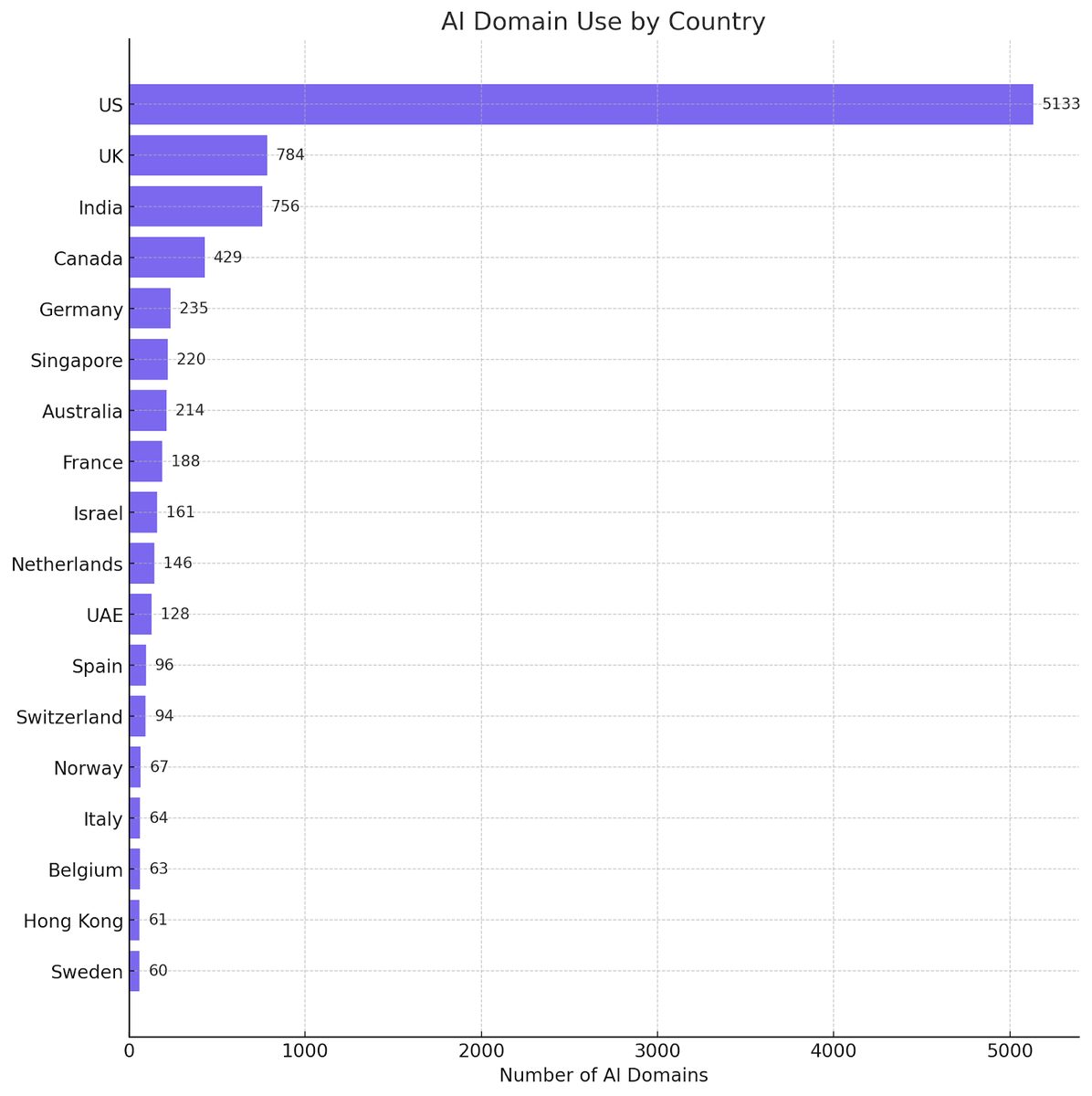
Shifting our lens to global trends, it’s no surprise that the US dominates AI SaaS development. Analyzing AI. Domain use by country, as shown in Fig. 4 below, places the United States at the forefront with over 5,000 domains. The UK and India follow in second and third place with similar numbers. It should be noted, however, that as of June 2025, our SaaS Browser only identifies SaaS businesses in the English language, introducing a bias.
Smaller yet tech-savvy countries, such as Singapore, Israel, and the Netherlands, also rank high, demonstrating the widespread global interest in AI startups and innovation.
Insights for Buyers & Founders
The sheer number of AI apps currently on the market is a core challenge for both buyers and founders. That’s where Saas Browser comes in. We offer the largest database of AI SaaS apps on the market, making it easy to discover and stay up-to-date with groundbreaking new apps.
For founders, our database enables you to showcase your key USPs, conduct market research, and connect with an engaged audience actively seeking your services. At the same time, buyers can benefit from detailed listings of nearly 600,000 SaaS companies, which can be searched by category and core features. If you’re looking for the best tool for a particular task, you’ll find it here.
The Road Ahead for AI SaaS Apps
So what’s next for AI Saas apps? Well, AI SaaS as a whole is forecast to hit $1.24 trillion by the year 2029. We expect to see AI apps flourish in the workplace as core business tools. They’ll likely become the primary interface for getting work done, whether that’s via productivity tools or data analytics for key decision-making. We can also expect to see more niche and tailored AI apps hit the market, aimed at specific verticals such as healthcare, finance, and manufacturing.
Another Dot Com Bubble?
In a competitive and crowded marketplace, some apps won’t cut it. Comparisons have been drawn to the dot-com bubble of the 1990s, where an overhyped market failed to deliver sustainable growth. But there are some key differences. Much of the spending is from highly profitable tech giants like Google, Microsoft, and Baidu in China.
They’re investing billions in massive data centres in strategic locations around the world. It’s reminiscent of how the internet required a massive infrastructure build-out to reach maturity in the 1990s. And it’s also an indicator that the following challenges for AI will be both logistical and technological in nature.
Or Railway Mania
Current conditions are also reminiscent of Railway Mania in the 1840s, when speculative investment in massive rail building projects reached 7% of British GDP. On the other hand, by 1850, the legacy of this railway mania was the UK’s impressive 6,000-mile rail network.
Investors who bought in early were severely impacted, but the long-term result ultimately helped drive the Industrial Revolution and provide rapid public transportation across the country. The AI bubble might well follow this route, laying the technological groundwork and infrastructure that will benefit us all in the long run.
The Final 1%
Despite billions in investment and lofty promises, fully driverless vehicles still aren’t here. The same holds for AI. ChatGPT and other large language models have made impressive progress. Yet they still occasionally hallucinate and make errors. Achieving that final 1% remains elusive. It could take years or decades to develop 100% reliable and usable AI tools. Only time will tell.
And SaaS Browser is the best place to discover new AI SaaS apps, spread across a variety of categories. And best of all, our search engine is free and open to the masses, with no account required.